E-Bike Rules for Teens: A Parent's Family Agreement Guide
Build a family agreement on e-bike rules for teens. Cover the legal basics, approved routes, check-ins and household safety together. Find out more.
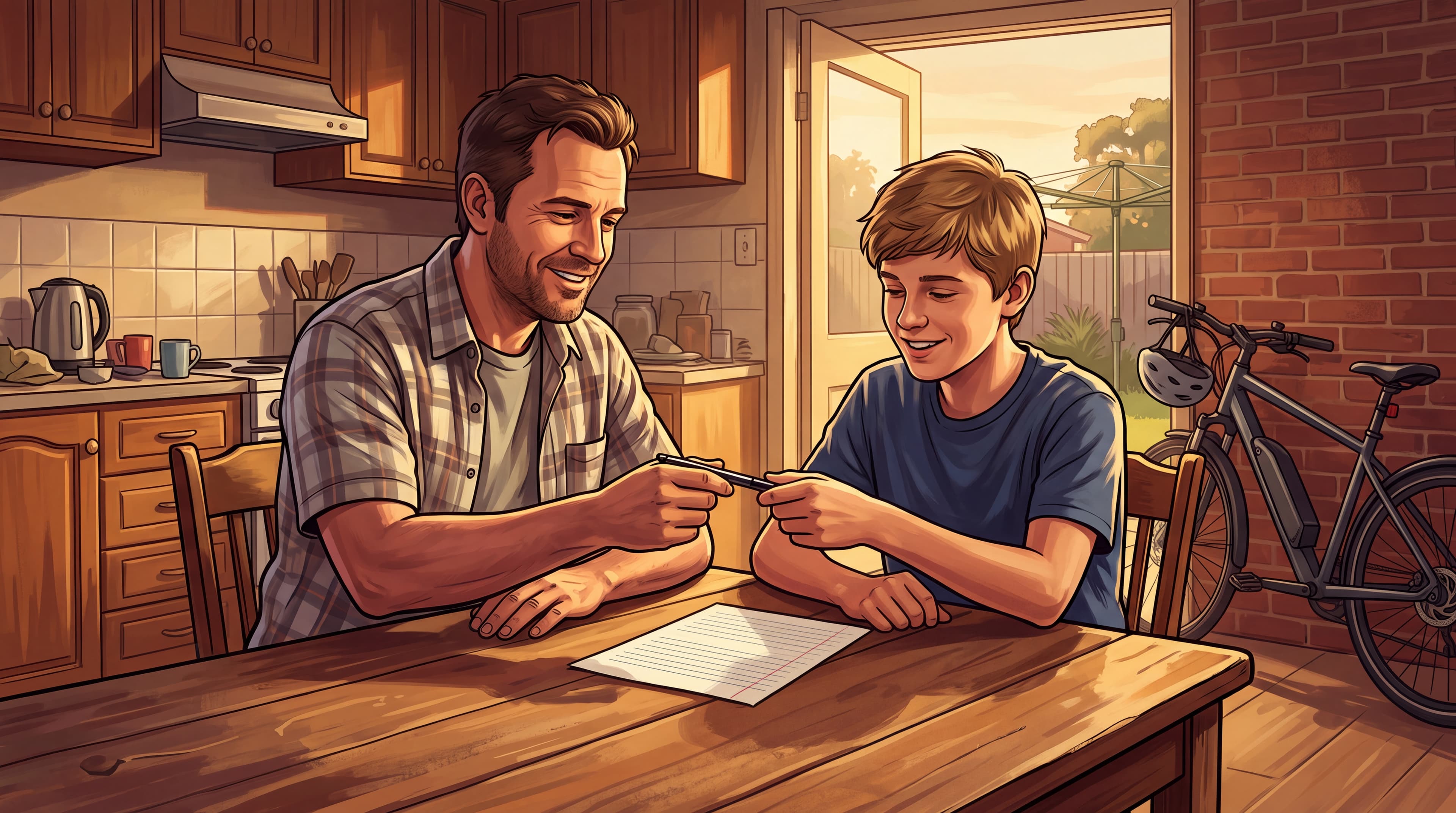
Write down your family's e-bike rules for teens together, then revisit them as your teen's riding changes. A quick "be careful" at the front door is a start. A short family agreement goes further: it records what you have both agreed, and gives you something concrete to come back to when plans change.
What should a family e-bike agreement include? Start with the rules that already apply where your teen rides, such as helmets and lights at night. Then add your family's own arrangements, such as approved routes and check-in times. Include battery charging too: Fire and Rescue NSW advises charging on a hard surface that can't catch fire, away from beds, bedrooms, living rooms, carpet, soft furnishings, exits, hallways, stairwells and anything that can burn. Never charge while asleep or away from home. FRNSW advises avoiding unattended charging, so make no unattended charging a household rule. Keep it to one page and review it each term.
What to put in a written agreement
New routes, new friends, changes in daylight and longer trips can bring new decisions. The agreement is a way to keep the safety conversation going as those things change.
Make expectations specific. "Ride safely" becomes "helmet fitted and fastened before you leave the driveway". Invite your teen to help shape the family rules, and talk about the reason behind each one. And use the agreement as the reference point when you talk about a missed check-in, rather than starting from scratch.
Start with what the law already requires
Before you add a single family rule, write down the rules that already apply. These vary by state and territory. Wherever you live, check the current rules for the places your teen will ride before you complete this section.
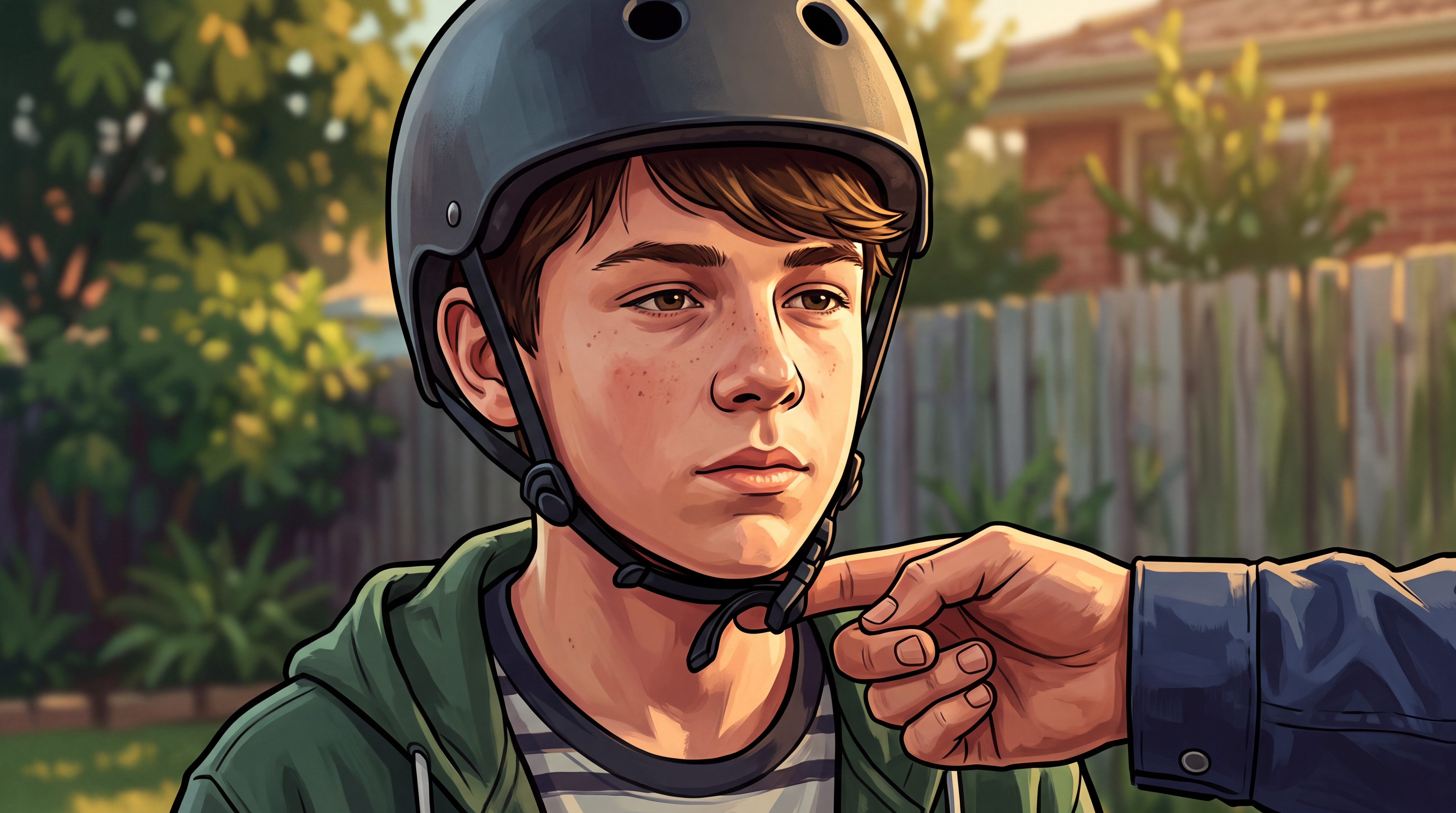
Helmets. Check the helmet requirements and any exemptions in your state or territory. In NSW, the NSW Government says riders must wear an approved bicycle helmet, securely fitted and fastened. Its fit guide says the front of the helmet should sit two fingers above the bridge of the nose, and one finger should fit between the buckle and the chin while the helmet is firmly in place. Include both in your fit check, adjust the straps for a snug fit, and follow the helmet manufacturer's fitting instructions.
Lights at night and in hazardous weather. In NSW, the NSW Government's bicycle rules set lighting and reflector requirements that apply at night or in hazardous weather conditions causing reduced visibility. The bicycle or rider must display a white light clearly visible for at least 200 metres from the front, a red light clearly visible for at least 200 metres from the rear, and a red reflector clearly visible for at least 50 metres from the rear when lit by a vehicle's headlight on low beam. Lights can be flashing or steady. That includes daytime riding when hazardous weather reduces visibility.
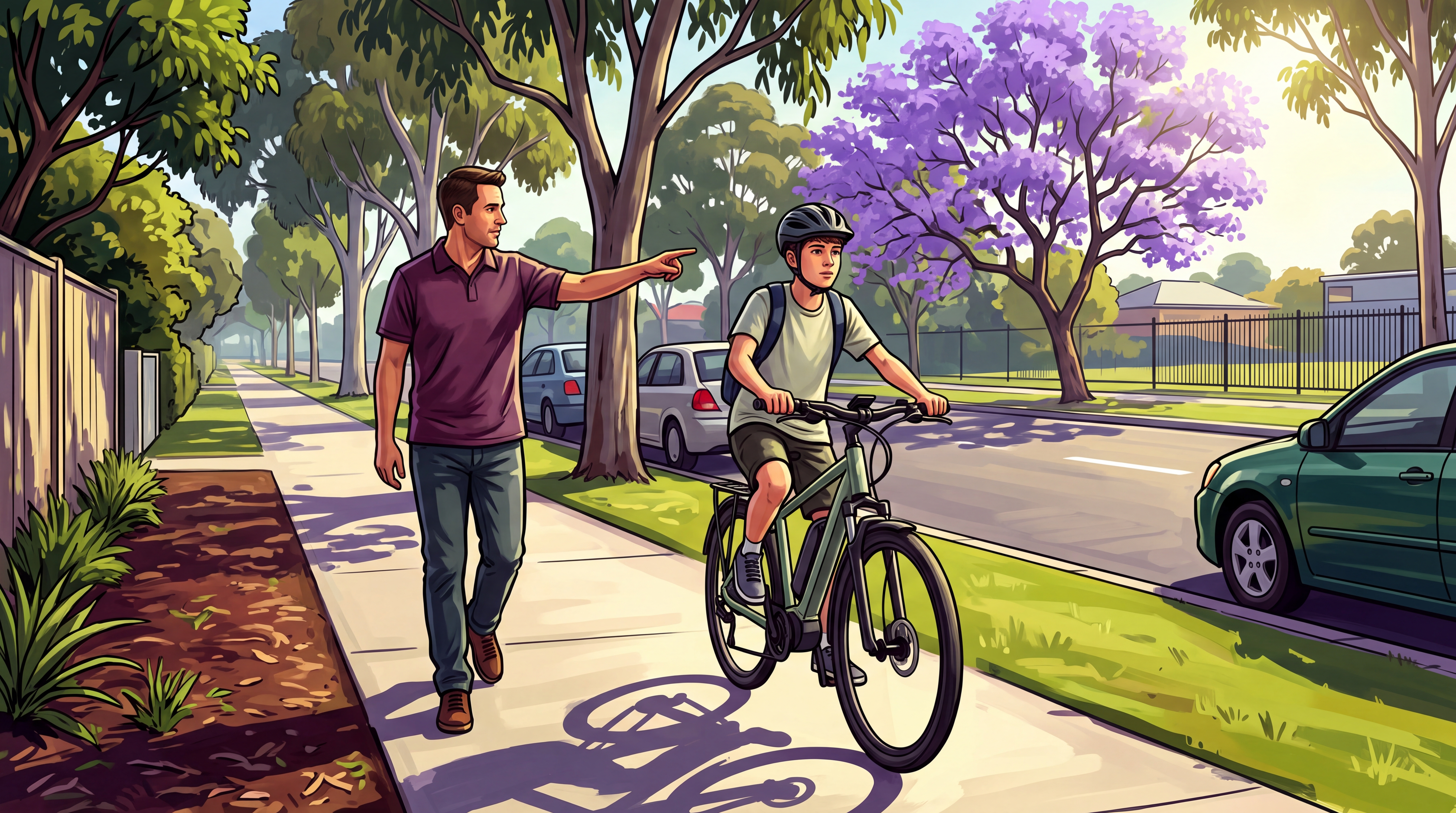
Where your teen can ride. In NSW, the NSW Government e-bike FAQs say legal e-bikes can use roads, bicycle lanes, shared paths and bicycle paths, but not where signs say "No bicycles". An e-bike only counts as a bicycle under the NSW road rules if it meets the definition in rule 15-1 of the NSW Road Rules 2014, so check that your teen's bike meets the NSW legal e-bike requirements before you choose routes. Riders under 16 can ride on the footpath. Riders aged 16 and over can't, unless a specific exemption applies. On footpaths and shared paths, keep left unless it is impracticable, and give way to pedestrians. So a footpath route that works for your 14-year-old may stop being an option at 16. Put that in the agreement now so it isn't a surprise later.
Age and licence rules. Queensland has specific age and licence conditions. Under the rules that took effect on 31 August 2026 (last checked on 29 September 2026), Queensland generally requires e-bike riders on roads, road-related areas and in public places to be at least 16 and hold a valid driver licence, including a learner licence. The licence must not be expired, cancelled or suspended, and the rider must not be disqualified from holding or obtaining a driver licence in Queensland or another jurisdiction. Riders aged 12 to 17 can use a supervision exemption with a parent, grandparent, legal guardian or another carer recognised by the legislation. Throughout the ride, that adult must stay close enough to easily observe and communicate with the teen and give immediate instructions. Other exemptions have their own conditions. Up to and including 29 November 2026, section 247 of Queensland's road use law means a rider with a reasonable excuse does not breach the licence requirement. It does not waive the age requirement.
Add the rules your family decides
This is the part that belongs to you and your teen. Some family rules worth considering:
Approved routes. Go over the proposed riding route together, including its paths, crossings, signs and any school rules about arriving by bike. Agree which roads are in and which are out, and what happens if a new route comes up.
Check-ins. Consider a quick text once your teen has arrived and parked. Agree on a backup plan for a flat phone or no signal, and decide what happens if a check-in is missed, before it is missed.
Passengers. Check the law where your teen rides and the manufacturer's passenger and load limits first. Under the NSW bicycle rules, don't carry more people than the bike is designed to carry. While the bike is moving, or stopped but not parked, a passenger must sit in the seat designed for them, under NSW Road Rule 246. Unless an exemption applies, they must wear an approved helmet securely fitted and fastened. Your family can choose a stricter no-passenger rule.
Phones and headphones. Check the local phone-use rules first. As a family rule, you might agree the phone stays in the bag while riding and messages wait until your teen has stopped and parked. Consider a no-headphones family rule.
Pre-ride checks. Check brakes, tyres, lights, the rear reflector and the bell, plus the manufacturer's pre-ride checks, using the NSW Government maintenance guide as a starting point. Have faults repaired before riding.
Keep the agreement concise, and ask your teen to explain each rule back in their own words.
Put battery charging in writing
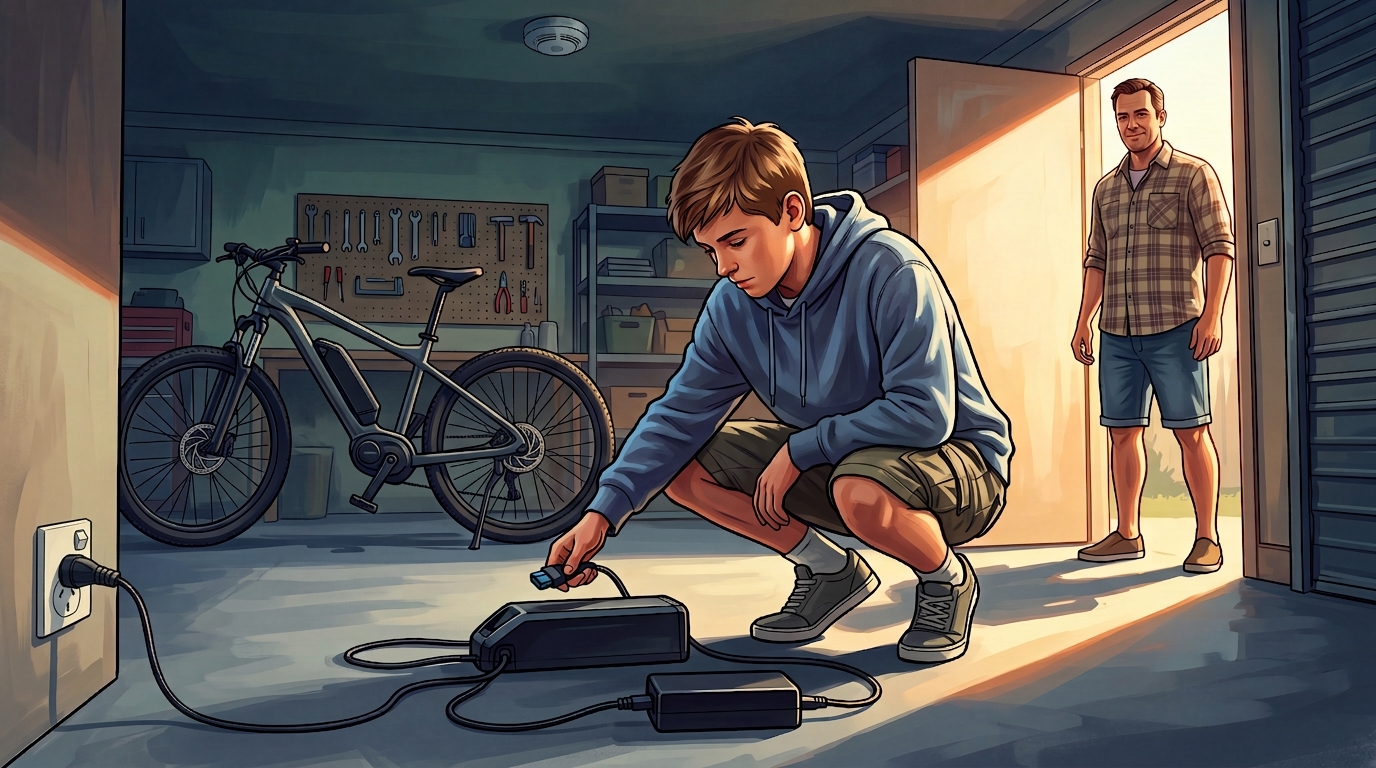
Charging is where e-bike safety moves from the road into your home, and it deserves its own section. Fire and Rescue NSW describes lithium-ion batteries as the fastest growing fire risk in New South Wales. Its advice is to charge on a hard surface that can't catch fire, away from beds, bedrooms, living rooms, carpet, soft furnishings, exits, hallways, stairwells and anything that can burn. Never charge while asleep or away from home. FRNSW advises avoiding unattended charging, so make no unattended charging a household rule. Its charging and storage advice can help you build your household checklist:
Charge in an open area like a garage or shed, on a hard surface that can't catch fire, such as concrete or tiles, away from beds, bedrooms, living rooms, carpet, soft furnishings, exits, hallways, stairwells and anything that can burn. Never charge while asleep or away from home. FRNSW advises avoiding unattended charging, so make no unattended charging a household rule.
Store the battery on a hard surface that can't catch fire, away from beds, bedrooms, living rooms, carpet, soft furnishings, exits, hallways, stairwells and anything that can burn. When charging, use the same precautions, never charge while asleep or away from home, and don't leave charging unattended.
Have a working smoke alarm in the charging or storage area, or a heat alarm where a smoke alarm can't be installed.
Keep the battery dry, out of direct sunlight and away from heat. Let the battery cool after riding before recharging, and follow the manufacturer's instructions.
Disconnect the battery from the charger once it is full.
Use the manufacturer-recommended charger for the battery. Check it matches the required voltage and current and carries the Regulatory Compliance Mark (RCM).
Never use or charge a battery that is damaged, swelling, bulging, leaking or overheating.
Then record the charging spot and the adult responsible for supervising charging. Check the spot, the charger and your charging routine against this list and the manufacturer's instructions.
Agree what happens when a rule is broken
Talk through proportionate responses in advance, so neither of you is making it up in the moment. A missed check-in might mean a week of riding only on familiar routes. Riding without a helmet might mean the e-bike stays home for a set time.
Just as important is what happens when your teen tells you about a near miss or a mistake. Let them know you want to hear what happened, and that you will work out the next steps together.
Review it as your teen grows
Review the agreement as your teen's age, experience and journeys change, including any legal age or supervision rules where you live. New routes, a new school, turning 16 and longer trips are all good triggers for a review.
Reviews are also a chance to relax optional family rules as your teen shows they are ready. Keep following the current legal requirements and essential safety precautions, and talk about which optional family rules could change as your teen gains experience.
Frequently asked questions
At what age should we write a family e-bike agreement?
Before your teen starts riding. Check that their age, their e-bike and the riding they plan to do meet the rules where you live, and involve them in setting the family rules.
Should the agreement include road rules or just family rules?
Both. Start with the rules that apply where your teen rides, then add your family rules. Keeping them separate helps your teen see which rules are the law and which are your family's choice.
How often should we update it?
Once a term is a sensible rhythm, plus any time routes, school arrangements or the rules that apply to your teen change.
BikeHero is designed to help Australian teens ride smarter and give parents peace of mind. Planned lessons include Essential Gear, Where to Ride and Battery Safety. Find out more at bikehero.au.

